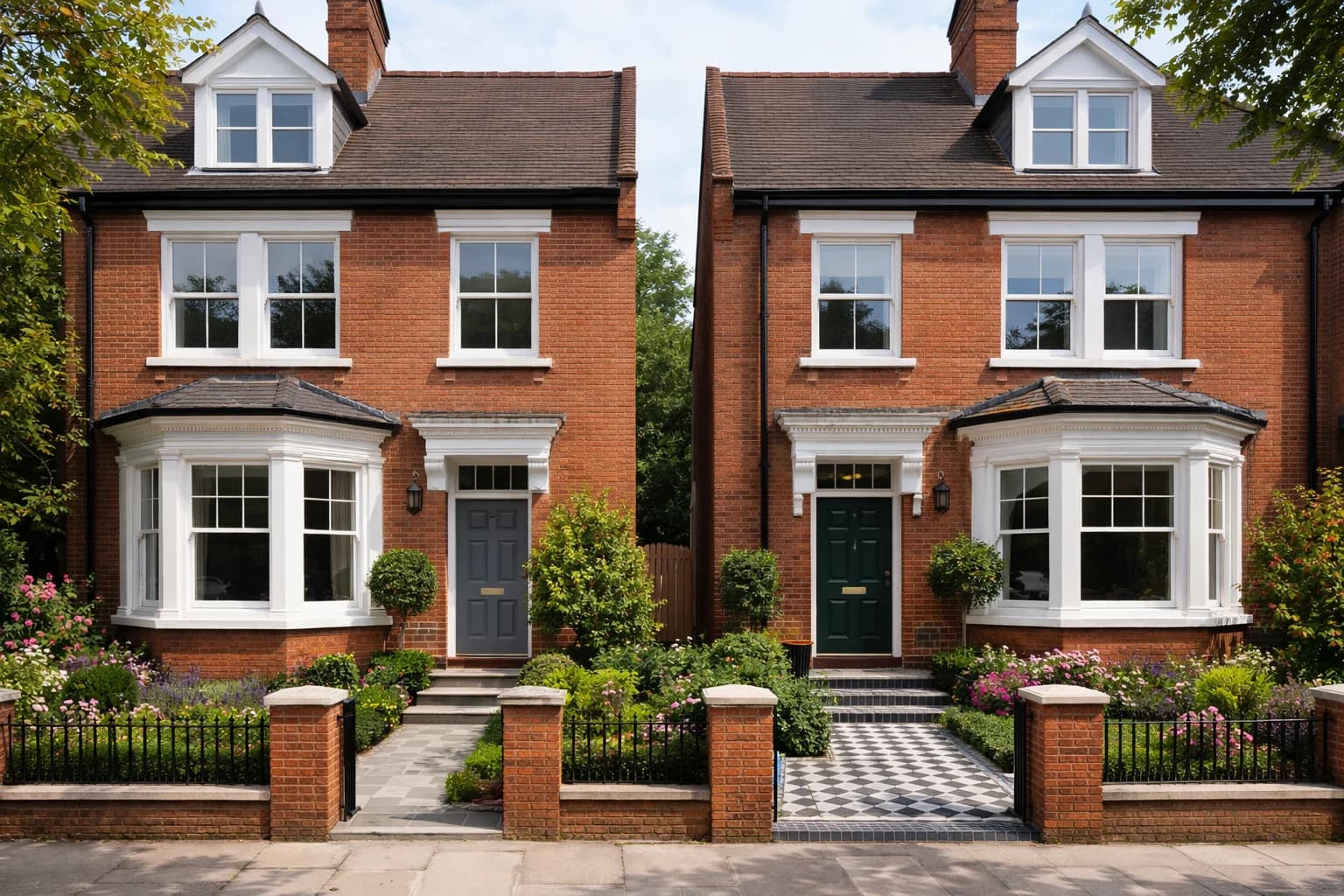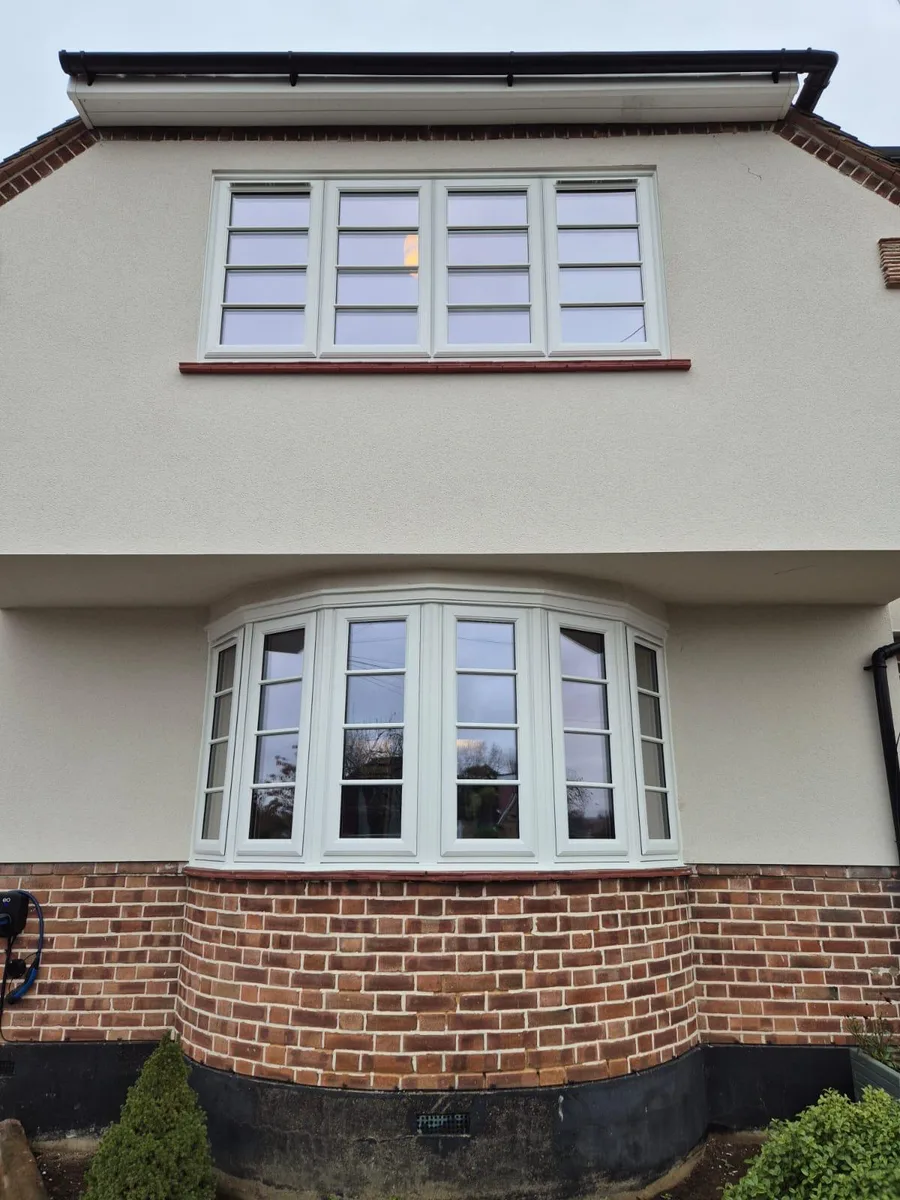
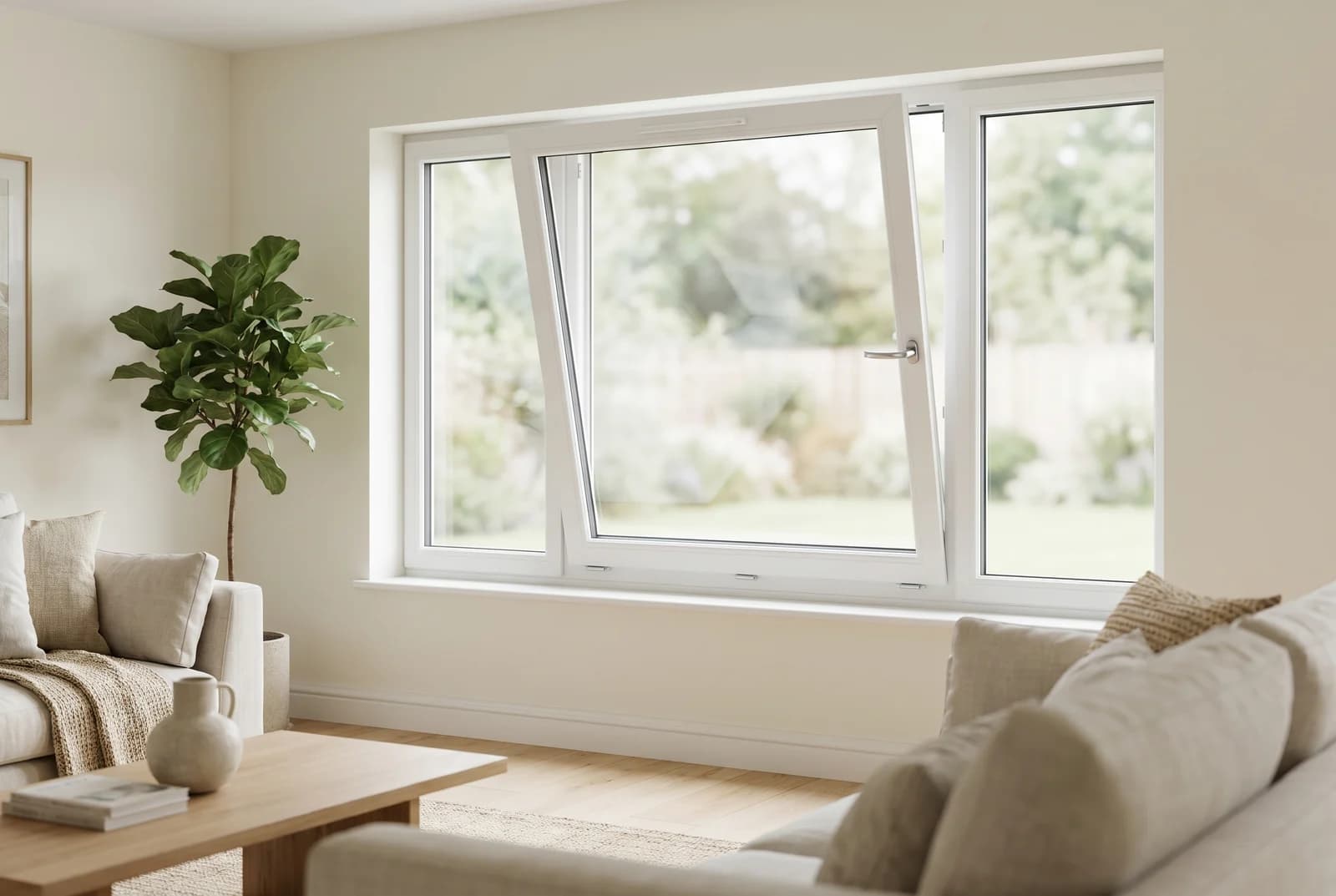
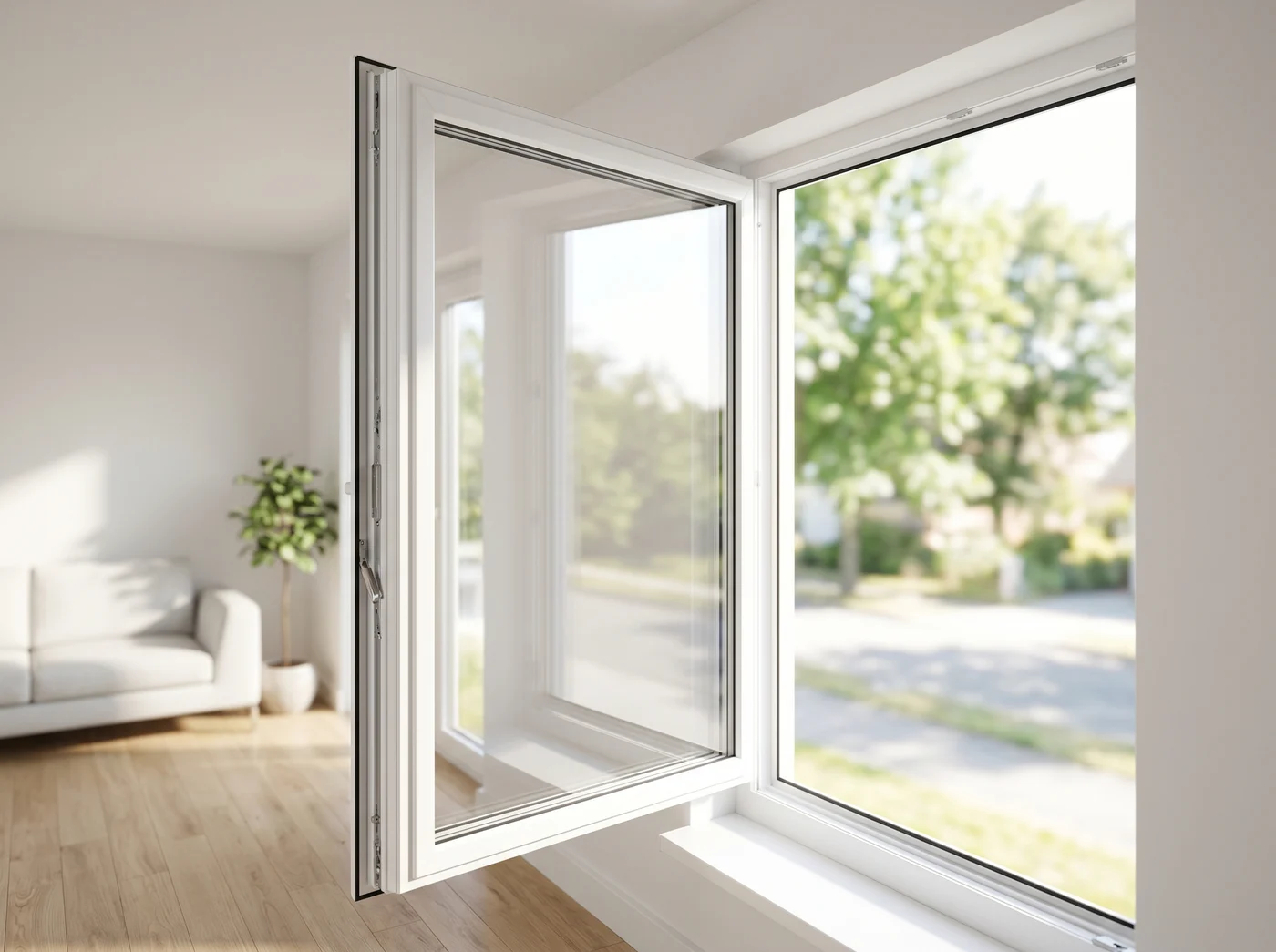
A tilt-and-turn window opens into the room, so it works best where nothing stands in front of it. Tilted, the top of the sash leans in for ventilation. Turned, the whole sash swings inward like a door, which lets you clean the outside of the glass from indoors. A casement opens outwards and keeps the room clear. Before choosing, check the space on both sides of the window: a desk, a kitchen tap or a deep curtain inside, and a path or boundary outside.
How tilt-and-turn and casement windows open
A tilt-and-turn window has one handle with two opening positions. In the first, the sash tilts inward at the top while the bottom stays in the frame. In the second, the sash swings fully into the room on side hinges. Use the handle the way the handover instructions for your window describe, and never force it when the sash is out of position.
A casement window is hinged at the side or the top and opens outwards. Side-hung casements sit on friction stays that hold the sash at any angle. Top-hung openers are often set above a fixed pane or over a kitchen worktop. Because the sash opens outside, it leaves the room clear, but it can swing over a path or into a narrow side passage.
Which opening suits your room?
| Your situation | Tilt-and-turn | Outward-opening casement |
|---|---|---|
| Desk, sofa or kitchen tap close to the window | The turning sash may hit it. Tilt mode needs less room, but still some at the top | The opening sash stays outside, so nothing inside is in the way |
| Curtains, blinds or shutters | Fabric can block the tilt gap or catch on the turning sash | Less likely to clash with the sash, but must still clear the handle |
| Gentle everyday ventilation | Tilt mode gives a small opening at the top of the sash | A slightly open sash, or a top-hung opener, does the same job |
| Wider airflow | Turn mode opens the whole sash into the room | The sash opens outwards and the room stays clear |
| Cleaning the outside of the glass | Turn mode brings the outer glass within reach from inside, if there is room to open it | Depends on the hinge. An easy-clean hinge opens the sash wide enough to reach the outer glass |
| Path, passage or boundary outside | Nothing swings outside | The open sash can get in the way outside |
Allow for the whole sash, not just the handle
Picture the sash fully turned into the room. Its outer corner has to pass the window board, the reveal, any radiator below and the furniture nearby. A kitchen tap may leave enough room for tilt mode but stop the sash turning. You can move a chair every time you open the window, but you will soon stop using turn mode.
Blinds fitted close to the glass can block the tilt opening, and curtains can catch on the handle or the turning sash. At the survey, show us where each covering sits when it is open and closed. If cleaning from inside is the reason you want tilt-and-turn, you need to be able to turn the sash once the room is furnished.
Tilt mode is for ventilation, not child safety
Tilt mode lets air in at the top of the sash while the bottom stays in the frame. It is a ventilation setting. It does not stop a child turning the handle to the fully open position. Where that matters, ask for a restrictor that limits the tilt or prevents the full turn, and think about who can reach the window. Close and lock the window when the house is empty.
Background ventilation needs its own place in the specification too. For replacement windows, paragraph 3.14 of the government's Approved Document F states:
"If the existing windows have background ventilators, the replacement windows should include background ventilators." Approved Document F, Volume 1: Dwellings
The same paragraph says the new ventilators should be no smaller than the old ones and must be controllable. Leaving a window on tilt does not replace them. Our replacement window building regulations checklist covers ventilation alongside safety glass and escape openings.
Restrictors, escape and cleaning: put it in writing
Both styles can be fitted with different hinges, locks and restrictors. A restrictor limits how far the sash travels, which also affects airflow and cleaning. Ask for the opening limit and how it releases to be written into the specification. If a window is the means of escape from a room, the whole installed window has to work for escape, not just look wide enough when open. On casements, an egress hinge lets the sash open wide enough to meet escape requirements. The same type of hinge gives easy-clean access to the outer glass.
Never lean out to clean glass. Turn mode only helps if the sash can open clear of the room, and an upstairs casement can only be cleaned from inside if its hinge allows it. The position of the window and the hinge decide what you can reach safely.
Aluminium tilt-and-turn windows open the same way as uPVC ones, so the same space checks apply whichever material you choose.
A survey checklist for tilt-and-turn or casement windows
Take this list to your window and door replacement survey. Settle any clash with furniture or window coverings before you choose the opening style.
| Look at | What to settle on site |
|---|---|
| Turn-sash sweep | Can the sash open inward without hitting furniture, worktops, taps, radiators or the reveal? |
| Room to tilt | Is there space for the top of the sash to lean in, and a clear path for air? |
| Curtains and blinds | Where will the rail, blind or shutter sit in relation to the handle and both opening positions? |
| Space outside | Would an outward-opening casement get in the way of a path, a boundary or anything else outside? |
| Cleaning access | Can the outside of the glass be reached safely with the proposed opening and hinges? |
| Restrictors and locking | Who can reach the window, and what opening limits and locks does it need? |
| Written quote | Does the itemised quote list the opening style, hinges, any restrictor and the finishing work for each window? |
An outward casement often makes sense above a kitchen tap. Upstairs, a tilt-and-turn window can make the outer glass easier to reach, as long as there is room to turn the sash. In both cases the answer depends on the space around the window.
The practical choice
Choose tilt-and-turn if you will use both positions and the sash has room to swing in. Choose a casement where fixed furniture, a worktop or window coverings would block the turn, or where you want the room clear. Many homes suit a mix, with casements in the kitchen and tilt-and-turn windows upstairs. If you are also weighing up windows for a period frontage, our guide to flush casement and sliding sash windows compares two other opening styles.
Ask for an itemised written quote after survey that prices both styles for the same openings, so you can compare like for like.
How Cii can help
Cii Double Glazing is a family-run business, established in 2009, and our team has over 55 years of combined experience. We survey, supply and fit uPVC and aluminium tilt-and-turn and casement windows across Essex, East London and Hertfordshire. Our own team carries out the survey and the fitting, and every installation comes with a 10-year installation guarantee.
At the survey we measure each opening, look at what sits in front of and outside each window, and talk through hinges, restrictors and ventilation with you. Your written quote then shows the opening style we recommend for each window.
Book a free home survey and written quote.
FAQ
Are tilt-and-turn windows a good idea above a kitchen sink?
Usually not. The sash has to turn into the room, and a tap or worktop below the window will often stop it. Tilt mode may still work, but you lose the main benefit of cleaning from inside. An outward casement or a top-hung opener is normally the better fit over a sink.
What is the difference between a tilt-only and a tilt-and-turn window?
A tilt-only window opens at the top for ventilation and nothing more. A tilt-and-turn window also swings fully into the room, which gives wider airflow and lets you reach the outer glass from inside. Check which one a quote describes, because the names are easy to mix up.
Should a tilt-and-turn window be left on tilt when nobody is home?
No. Tilt mode is for ventilation while someone is in. Close and lock the window when the house is empty. Background ventilators, where fitted, let air in without leaving a window open.
Can I have tilt-and-turn and casement windows on the same house?
Yes. Choosing the opening style room by room is common, for example casements downstairs and tilt-and-turn windows in upstairs bedrooms. At the survey we will confirm that the frame colour and handle finish can match across both styles.